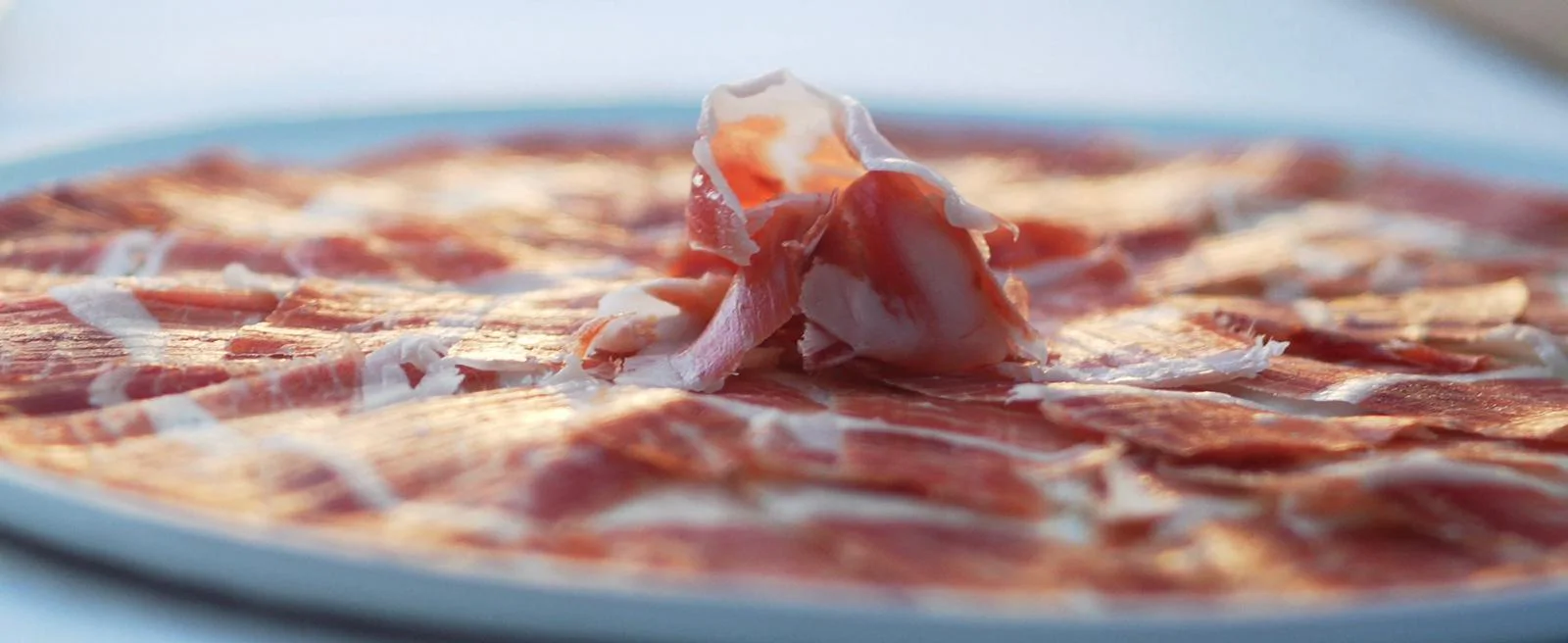
What do jamon iberico and Iberian ham mean?
In English, Iberian ham is the usual description of jamon iberico. It is not a separate quality tier. In the complete Spanish product designation, iberico means that the pig has at least 50 per cent Iberian ancestry; the label must state whether the proportion is 50, 75 or 100 per cent.
Breed is only part of the answer. The complete designation also explains how the animal was fed and reared. Read the breed percentage, bellota or cebo wording and the official colour seal together.
Bellota, cebo de campo and cebo
Bellota means that during the final montanera season the pigs roam the dehesa and feed on acorns and natural pasture. Cebo de campo comes from pigs with outdoor access that also receive prepared feed. Cebo comes from a more controlled system based on feed.
Bellota does not automatically mean 100 per cent Iberian breed. A bellota ham may come from a pig with 50 or 75 per cent Iberian ancestry. The colour seal shows the combination. The bellota, cebo and serrano comparison places the differences side by side.
The four colour seals
| Seal | Designation | Iberian breed | Feed | Minimum curing |
|---|---|---|---|---|
| Black | De bellota 100% iberico | 100% | Acorns and natural pasture during montanera | 600 days below 7 kg; 730 days from 7 kg |
| Red | De bellota iberico | 50 or 75% | Acorns and natural pasture during montanera | 600 days below 7 kg; 730 days from 7 kg |
| Green | De cebo de campo iberico | 50, 75 or 100% | Outdoor access with pasture and feed | 600 days below 7 kg; 730 days from 7 kg |
| White | De cebo iberico | 50, 75 or 100% | Feed in a more controlled rearing system | 600 days below 7 kg; 730 days from 7 kg |
The colour identifies the category, not one exact curing period. Spain’s standard sets minimum time by weight; producers may cure a ham for longer.
Why the dehesa matters
The dehesa is an open, managed landscape of mainly holm and cork oaks in south-western Spain and parts of Portugal. During montanera, pigs range over large areas in search of acorns. The landscape is both pasture and a practical part of the bellota production system.
Salt, time and curing
After slaughter, the ham is salted, dried and matured for a long period. The exact time depends on weight, fat and the producer’s method. The meat loses water and flavours concentrate. Its fat softens quickly at room temperature, which is why thin slices and the right serving temperature make a visible difference.
How much meat does a whole ham yield?
A whole jamon iberico de bellota weighs 8–9 kg and yields 4–4.5 kg of carved meat. For a reception, 40–45 g per guest is a practical planning amount, enough for about 80 people. If the ham is the main feature of the evening, it serves 35–40. For events, I select the ham according to the format and approximate guest count.
How to read a ham
Start with the official colour seal, then check the full product name. Look for breed percentage, feeding category and producer. Price or a dark hoof alone does not prove a category. Carving reveals what a label cannot: fat distribution, texture and how the aroma develops across different parts of the ham.
Jamon iberico, Iberian ham and serrano: the difference
Jamon iberico and Iberian ham describe the same type of product in English usage. Jamon Serrano is not a lower tier within the Iberico system. It is a separate traditional speciality guaranteed with its own product specification, and it does not use the black, red, green and white Iberico seals.
The distinction cannot be made from price, colour or curing time alone. For jamon iberico, check the complete designation, breed percentage and colour seal. Serrano follows its own labelling and specification. The full comparison of bellota, cebo de campo, cebo and serrano places the systems side by side.
How to serve it
Slices should be thin and not refrigerator-cold. Leave a little space between them so the surface can become glossy and the aroma can open. At an event, continuous hand carving keeps service moving and lets the quantity follow the guests’ pace.
Sources: Spain’s official quality standard for Iberian products and the Ministry of Agriculture’s TSG Jamon Serrano product specification. Checked 7 September 2026.
Questions about jamon iberico
Is jamon iberico the same as Iberian ham?
Iberian ham is the usual English description of jamon iberico. On a Spanish label, iberico forms part of a complete designation that also states breed percentage, feeding and rearing.
Is jamon iberico the same as serrano ham?
No. Jamon iberico follows Spain’s Iberico standard and comes from pigs with at least 50 per cent Iberian ancestry. Jamon Serrano is a separate traditional speciality and does not use the four Iberico colour seals.
Does bellota mean the ham is 100 per cent Iberian?
No. Bellota describes feeding during montanera. A black seal means bellota from a 100 per cent Iberian pig, while red means bellota from a pig with 50 or 75 per cent Iberian ancestry.
How can you identify jamon iberico?
Check the official colour seal, complete product designation, breed percentage and producer. A dark hoof or a high price does not prove the category.